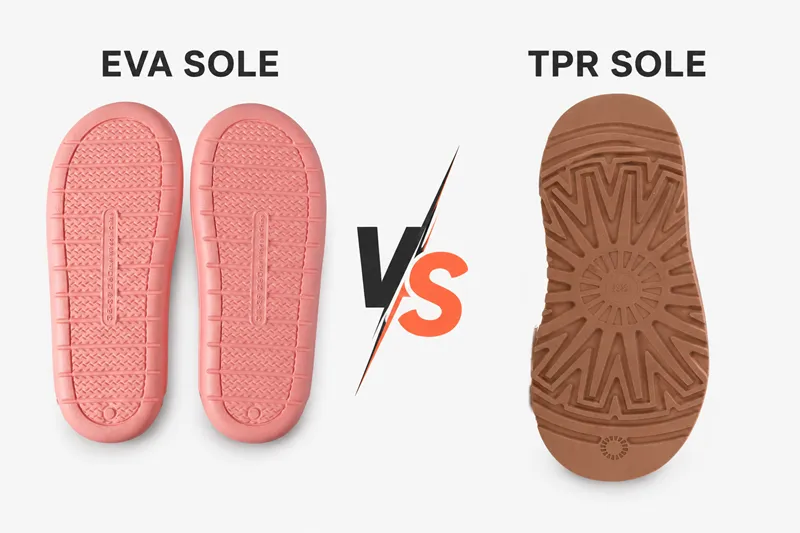
EVA vs TPR Slipper Soles: Which Is Better for Custom Plush Slippers?

EVA is better for lightweight, soft, and cost-effective indoor plush slippers, while TPR is better for stronger grip, durability, and semi-outdoor use. The right choice depends on where the slippers will be worn, who will wear them, the target price, shipping budget, and the level of durability your customers expect.
eva sole vs tpr sole for plush slippers

Quick Answer: EVA vs TPR Slipper Soles

When choosing between EVA and TPR slipper soles , there is no universally better option. The right material depends on your target market, product positioning, budget, and how the slippers will actually be used.

The comparison below provides a quick overview before we explore each material in more detail.

Feature EVA Sole TPR Sole
Weight ⭐⭐⭐⭐⭐ Very Lightweight ⭐⭐⭐ Medium
Cushioning ⭐⭐⭐⭐⭐ Excellent ⭐⭐⭐ Good
Flexibility ⭐⭐⭐⭐⭐ High ⭐⭐⭐ Medium
Slip Resistance ⭐⭐⭐ Good ⭐⭐⭐⭐⭐ Excellent
Durability ⭐⭐⭐ Good ⭐⭐⭐⭐⭐ Excellent
Indoor Use ⭐⭐⭐⭐⭐ Ideal ⭐⭐⭐⭐ Very Good
Outdoor Use ⭐⭐ Limited ⭐⭐⭐⭐⭐ Excellent
Cost Lower Slightly Higher
Best For Plush slippers, hotel slippers, indoor slippers Premium slippers, semi-outdoor slippers, anti-slip slippers

In General

  • Choose EVA if your priority is lightweight comfort, soft cushioning, lower production costs, and reduced shipping weight for indoor plush slippers.
  • Choose TPR if your priority is stronger grip, better abrasion resistance, and a more durable outsole for premium or semi-outdoor slippers.
  • If you need both comfort and durability, consider an EVA + TPR hybrid sole, which combines lightweight cushioning with improved traction and wear resistance.

Why the Sole Material Matters More Than Most Buyers Think

When sourcing custom plush slippers , many buyers focus on the upper design, colors, fabrics, or logos. However, experienced manufacturers usually ask one question first:

“What sole material do you need?”

That's because the sole affects almost every aspect of the finished product, including:

  • Comfort
  • Durability
  • Anti-slip performance
  • Product weight
  • Manufacturing and shipping costs
  • Overall customer experience

Two slippers may look nearly identical but perform very differently simply because they use different soles.

For example, hotel slippers prioritize lightweight comfort and cost efficiency, while retail plush slippers often require greater durability, better traction, and a more premium feel.

Choosing the right sole material helps ensure the product matches its intended market and customer expectations.

What Is an EVA Slipper Sole?

EVA (Ethylene Vinyl Acetate) is a lightweight foam material widely used for indoor slippers. Its closed-cell structure makes it soft, flexible, and highly cushioned while keeping the overall weight low.

For custom plush slippers, EVA is one of the most popular sole materials because it offers an excellent balance of comfort, cost, and production efficiency.

Key Benefits of EVA

  • Lightweight – Reduces product weight and helps lower international shipping costs.
  • Soft & Cushioned – Provides a comfortable walking experience for daily indoor use.
  • Flexible – Bends naturally with the foot without putting stress on the upper.
  • Cost-Effective – Easy to mold into different shapes, making it suitable for a wide range of custom designs.
  • Warm to the Touch – More comfortable than harder plastics, especially for winter slippers.

Best Applications

EVA soles are ideal for plush slippers designed for comfort and indoor use, including:

  • Home slippers
  • Animal plush slippers
  • Character slippers
  • Christmas slippers
  • Winter hotel slippers
  • Private label collections

Things to Consider

Although EVA is an excellent choice for indoor footwear, it also has some limitations:

  • Lower abrasion resistance than TPR, making it less suitable for frequent outdoor use.
  • Moderate slip resistance, which can be improved with deeper tread patterns.
  • Very soft EVA may gradually compress after long-term use.

Is EVA Right for Your Project?

If your priority is lightweight comfort, competitive pricing, and indoor performance, EVA is usually the best option for custom plush slippers.

However, if your product requires greater durability, stronger grip, or occasional outdoor use, TPR may be a better choice—which we'll look at next.
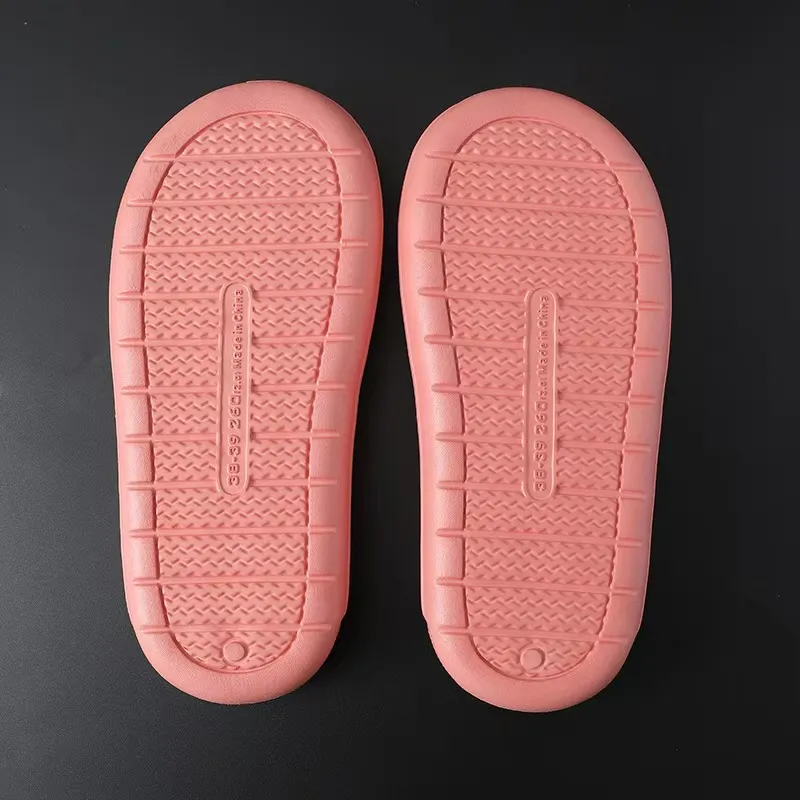
EVA sole for custom plush slippers
EVA slipper sole commonly used for lightweight indoor plush slippers.
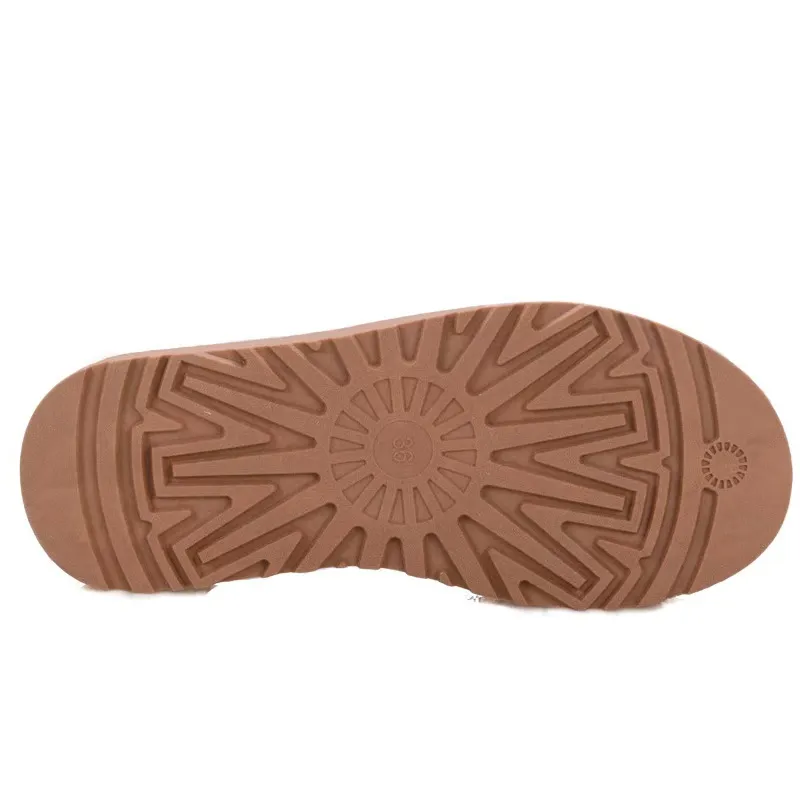
TPR sole for custom plush slippers
TPR slipper sole designed for enhanced grip, durability, and premium performance.

What Is a TPR Slipper Sole?

TPR (Thermoplastic Rubber) combines the flexibility of rubber with the processing advantages of plastic. Compared with EVA, it is denser, more durable, and provides better traction, making it a popular choice for premium plush slippers and products that may be worn both indoors and outdoors.

Key Benefits of TPR

  • Excellent Grip – Provides better slip resistance on smooth surfaces such as tile and hardwood floors.
  • High Durability – More resistant to abrasion, making slippers last longer under daily use.
  • Better Shape Retention – Maintains its structure over time without compressing as easily as EVA.
  • Premium Feel – Its higher density gives slippers a more substantial, high-quality feel.

Best Applications

TPR soles are commonly used for:

  • Premium home slippers
  • Private label collections
  • Gift slippers
  • Character plush slippers
  • Plush slippers for occasional outdoor use

Things to Consider

While TPR offers excellent durability, it also has a few trade-offs:

  • Heavier than EVA, which may increase shipping costs for large orders.
  • Higher production cost, especially for complex outsole designs.
  • Firmer underfoot, providing less cushioning than EVA.
Which Sole Is Best for Different Types of Plush Slippers?

There is no single outsole material that works best for every type of plush slipper. The ideal choice depends on your product positioning, target customers, retail price, and the environment where the slippers will be worn.

At CustomPlushSlippers, we recommend different outsole solutions based on the intended application rather than using the same material for every project.

Animal Plush Slippers

Recommended Sole: EVA

Animal plush slippers are designed to be soft, fun, and comfortable. Since they are primarily worn indoors, lightweight cushioning is usually more important than maximum abrasion resistance.

For brands developing custom animal plush slippers , EVA is the preferred choice because it:

  • Keeps the slippers lightweight and easy to wear
  • Enhances the soft, cozy feeling customers expect
  • Reduces shipping weight for bulk orders
  • Offers an excellent balance between comfort and manufacturing cost

If additional grip is required, textured outsole patterns can be molded into the EVA sole without significantly increasing weight.

Hotel & Spa Plush Slippers

Recommended Sole: EVA or EVA + TPR

For most hotel and spa projects, EVA is the preferred outsole because it provides excellent comfort while remaining lightweight and cost-effective. Guests usually wear slippers in hotel rooms, spa facilities, wellness centers, and other indoor environments where softness and comfort are more important than heavy-duty durability.

For businesses looking for custom hotel slippers , EVA also helps reduce shipping weight, making it an economical choice for large hospitality orders.

For luxury hotels, premium resorts, or reusable spa slippers, many brands upgrade to an EVA + TPR construction. The EVA midsole delivers soft cushioning, while the TPR outsole improves grip, wear resistance, and overall product quality without making the slipper excessively heavy.

Private Label & Retail Plush Slippers

Recommended Sole: EVA + TPR or TPR

Private label brands often compete on perceived quality as much as comfort. Consumers expect slippers that not only feel soft but also remain attractive after months of regular use.

  • Better abrasion resistance
  • Improved anti-slip performance
  • A more premium feel
  • Longer product lifespan
  • Higher perceived value for retail customers

Children's Plush Slippers

Recommended Sole: EVA

Children's slippers benefit greatly from a lightweight outsole.

  • Easier for children to walk in
  • More comfortable for extended wear
  • Less tiring during everyday indoor activities

Winter Plush Slippers

Recommended Sole: EVA or EVA + TPR

Winter slippers are primarily designed to maximize warmth and comfort rather than withstand harsh outdoor conditions.

For most winter collections, thick EVA cushioning provides excellent insulation and a soft underfoot feel. Premium products often combine EVA with a thin TPR outsole to improve grip on smooth indoor surfaces such as hardwood floors, ceramic tiles, and polished concrete without sacrificing comfort.

Semi-Outdoor House Slippers

Recommended Sole: TPR

Some consumers frequently step outside while wearing their house slippers—for example, to water plants, collect the mail, walk around the patio, or take out the trash.

  • Better abrasion resistance
  • Improved grip on outdoor surfaces
  • Greater flexibility in varying temperatures
  • Longer service life under frequent daily use

For slippers designed for both indoor comfort and occasional outdoor use, TPR provides a practical balance between performance and durability.

Need the Right Sole for Your Plush Slipper Project?

From lightweight EVA soles for indoor slippers to durable TPR solutions for semi-outdoor use, we can help you choose the best outsole based on your target customers, product positioning, budget, and manufacturing requirements.

Get a Free Quote

Common Mistakes Buyers Make When Choosing Slipper Soles

Choosing between EVA and TPR isn't simply a matter of selecting the stronger material. During product development, we've found that many buyers focus on technical specifications while overlooking how the slippers will actually be used.

Here are some of the most common mistakes we see when working with OEM and private label projects.

Mistake 1: Assuming TPR Is Always Better

Why it happens: Many buyers believe that a more durable material always means a better product.

While TPR does provide better abrasion resistance and grip, it also makes slippers:

  • Heavier
  • Firmer underfoot
  • More expensive to manufacture
  • More costly to ship

For indoor plush slippers designed for bedrooms, hotels, or relaxation, EVA often creates a softer and more comfortable wearing experience.

The best outsole isn't necessarily the strongest—it is the one that best matches the product's intended use.

Mistake 2: Ignoring Shipping Costs

Why it matters: Material selection affects not only production cost but also international shipping expenses.

  • Reduce freight costs
  • Improve container utilization
  • Lower overall landed costs

Although the weight difference between EVA and TPR may seem small, it becomes significant when shipping thousands of pairs internationally.

When developing cost-sensitive products, shipping efficiency should be considered alongside material performance.

Mistake 3: Focusing Only on the Sole Material

The outsole material is only one part of the equation.

  • Sole thickness
  • Outsole tread pattern
  • Material hardness
  • Edge construction
  • Upper-to-sole bonding method
  • Overall slipper structure

For example, a well-designed EVA outsole with an optimized tread pattern can outperform a poorly designed TPR outsole in many indoor applications.

Mistake 4: Overlooking the Actual Wearing Environment

Key consideration: The correct outsole depends on where the slippers will actually be used.

Some customers wear slippers only in bedrooms, while others regularly walk on tile floors, wooden flooring, hotel corridors, patios, or balconies.

Understanding the real wearing environment allows manufacturers to recommend the right balance between comfort, grip, durability, and cost.

Mistake 5: Choosing One Sole for Every Product

Some buyers prefer to standardize every slipper collection with the same outsole to simplify sourcing.

However, different products require different performance characteristics:

  • Animal plush slippers usually benefit from lightweight EVA.
  • Premium retail slippers often perform better with TPR or EVA + TPR.
  • Hotel slippers typically prioritize lightweight comfort and cost efficiency.
  • Semi-outdoor slippers require stronger wear resistance.

Selecting the outsole according to each product category usually creates a better user experience and stronger market competitiveness.

Need Help Choosing the Right Slipper Sole?

Our team can help you select the best outsole solution based on your target market, product positioning, budget, and production requirements.

Get a Free Quote

How We Help Buyers Choose the Right Sole

At CustomPlushSlippers, outsole selection is part of the product development process—not a decision made after the design is finished.

Rather than recommending the same material for every customer, we evaluate each project based on its market positioning, performance requirements, and production goals.

Product Positioning

Every project starts with understanding the target market.

  • Is this a promotional giveaway?
  • Is it a private label retail collection?
  • Is it intended for hotels or resorts?
  • Is it designed for gift shops or souvenir stores?

Different markets require different outsole solutions.

Wearing Environment

The intended wearing environment plays an important role in outsole selection.

Indoor slippers generally prioritize lightweight comfort and cushioning, while products intended for occasional outdoor use require greater grip and abrasion resistance.

Understanding the end user's daily habits allows us to recommend a more suitable material combination.

Budget & Target Price

Material selection directly affects manufacturing costs.

We help balance:

  • Comfort
  • Durability
  • Product quality
  • Manufacturing cost
  • Shipping efficiency

Our goal is to recommend the most cost-effective solution without compromising the product's market positioning.

MOQ & Manufacturing Requirements

Different outsole materials may require different molds, production processes, or tooling investments.

For custom OEM and ODM projects, we also consider:

  • Minimum order quantity (MOQ)
  • Mold development requirements
  • Production efficiency
  • Lead time
  • Future repeat orders

By evaluating these factors early in the development process, buyers can avoid unnecessary costs and production delays.

Sample Development & Material Comparison

Before mass production, we can produce samples using different outsole materials for side-by-side comparison.

This allows buyers to evaluate:

  • Weight
  • Cushioning
  • Flexibility
  • Anti-slip performance
  • Overall appearance
  • Product positioning

Testing multiple options during sampling makes it much easier to optimize the product before bulk production begins, reducing both development risk and future manufacturing costs.

Ready to Develop Your Custom Plush Slippers?

Whether you need lightweight EVA soles for indoor comfort, durable TPR solutions for premium collections, or a customized outsole combination for your market, our team can help you select the right solution from concept development to mass production.

Get a Free Quote

Frequently Asked Questions

Is EVA or TPR better for indoor slippers?

For most indoor plush slippers, EVA is the preferred choice because it is lightweight, soft, and comfortable. If stronger anti-slip performance is required, TPR or an EVA + TPR combination may be more suitable.

Are TPR soles more durable than EVA?

Yes. TPR generally provides better abrasion resistance and maintains its performance longer on rough surfaces, making it suitable for slippers that receive heavier daily use.

Do EVA soles wear out quickly?

Not necessarily. High-quality EVA performs very well in indoor environments. However, compared with TPR, it wears faster when frequently used on rough outdoor surfaces.

Can I customize the outsole pattern?

Yes. Both EVA and TPR soles can be customized with different tread patterns, textures, colors, and logo designs to match your brand requirements.

Which sole is best for hotel slippers?

EVA is usually the preferred option because it provides excellent comfort while helping reduce manufacturing and shipping costs.

Can one slipper use both EVA and TPR?

Yes. Many premium slippers combine an EVA cushioning layer with a TPR outsole to provide lightweight comfort together with improved grip and durability.

Article by CustomPlushSlippers Team

Based on real factory production experience, custom plush slipper development, material selection, logo customization, quality checks, and B2B order planning for retail, gift, hotel, and private label projects.

Need OEM/ODM Support?

We support OEM and ODM custom plush slipper projects, including custom designs, materials, soles, logos, packaging, samples, and bulk production.

Submit the Form

WhatsApp Us