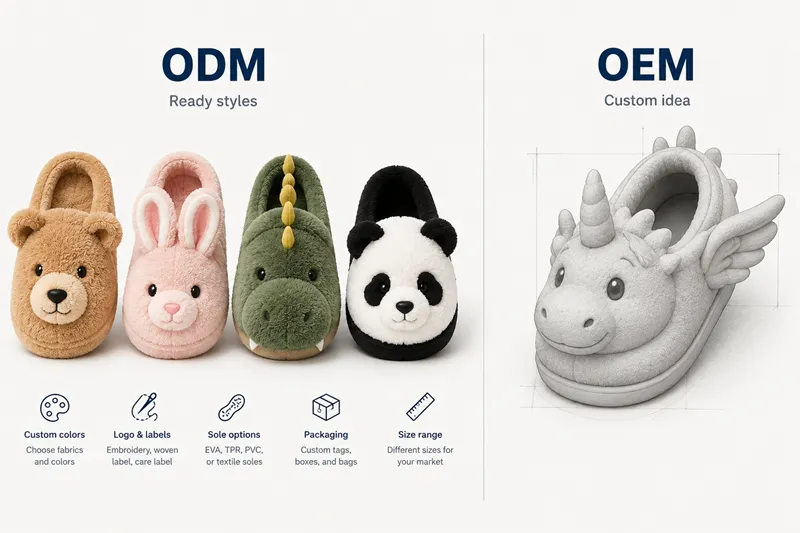
ODM and OEM are the two most common manufacturing models for custom plush slippers, but they serve different business goals. Choosing the right one affects your development cost, lead time, customization options, and product uniqueness.
In general, ODM is suitable for brands that want to customize existing slipper designs and launch products quickly, while OEM is designed for businesses developing completely original plush slippers from scratch.
This guide compares the two manufacturing approaches, explains their differences in cost, development, and production, and helps you decide which solution best fits your project.
What Is ODM for Custom Plush Slippers?
ODM (Original Design Manufacturing) means the manufacturer already has ready-to-produce slipper designs, patterns, and manufacturing processes. Instead of creating a new product from scratch, buyers customize an existing slipper style to match their own brand.
For custom plush slippers, ODM usually focuses on branding and material customization while keeping the original slipper structure unchanged.
Even when the basic structure is already established, ODM projects usually move through custom slipper sampling to confirm fabrics, colors, logos, cushioning, and packaging before bulk production.
Common ODM Customization Options
- Custom plush fabrics and color combinations
- Embroidered logos, woven labels, and care labels
- Memory foam or standard foam insoles
- EVA, TPR, PVC, or textile soles
- Custom hang tags and retail packaging
- Different size ranges for your target market
Because the slipper pattern has already been developed and tested, ODM projects generally require less development time and lower investment than OEM projects. This makes ODM a popular choice for private label brands, retailers, wholesalers, hotels, promotional companies, and e-commerce sellers.
Example of an ODM Project
Imagine you want to launch a winter slipper collection under your own brand. Instead of developing a completely new product, you select an existing bear-shaped plush slipper and customize the Sherpa fabric, add your brand logo, upgrade to memory foam insoles, and use a premium gift box. The result is a branded product that reaches the market much faster while keeping development costs under control.
What Is OEM for Custom Plush Slippers?
OEM plush slippers mean developing a completely new plush slipper based on your own design or product concept. Instead of modifying an existing style, the manufacturer creates the product specifically for your brand.
OEM projects usually begin with a sketch, AI-generated image, reference photo, CAD drawing, or physical sample. The manufacturer then develops the pattern, recommends suitable materials, produces prototype samples, and prepares the product for mass production.
Typical OEM Development Includes
- Product concept evaluation
- Pattern making and size grading
- Material and construction recommendations
- Prototype sample development
- Sample revisions and optimization
- Mass production preparation
OEM offers much greater design flexibility than ODM. Nearly every part of the slipper can be customized, including the overall shape, facial expressions, three-dimensional ears, tails, wings, embroidery details, sole construction, and packaging.
Example of an OEM Project
Imagine you're building a new lifestyle brand and want to launch an exclusive duck-shaped plush slipper. You provide concept artwork featuring a rounded duck head, oversized orange beak, soft wings, memory foam cushioning, and custom packaging. Since no existing design matches these requirements, the manufacturer develops new patterns, creates prototype samples, refines the construction through multiple revisions, and prepares the product for bulk production.
ODM or OEM: Which One Should You Choose?
Both manufacturing models can produce high-quality custom plush slippers. The right choice depends on your product goals, budget, launch timeline, and branding strategy.
Choose ODM If You Want To
- Launch products quickly
- Reduce development costs
- Customize an existing slipper design
- Create a private label collection
- Minimize development risks
Choose OEM If You Want To
- Create an original slipper design
- Develop exclusive animal or character slippers
- Build long-term brand differentiation
- Have complete design flexibility
- Invest in a signature product line
ODM vs OEM: Key Differences
Both ODM and OEM can produce high-quality custom plush slippers, but they differ in product development, customization, investment, and production planning. The comparison below highlights the key differences.
| Feature | ODM | OEM |
|---|---|---|
| Product Design | Uses an existing slipper design | Develops a completely new slipper design |
| Customization Flexibility | Customize materials, colors, logos, packaging, soles, and labels | Customize every part of the slipper, including shape, structure, and decorative details |
| Development Cost | Lower | Higher |
| MOQ | Depends on materials, colors, sizes, packaging, and customization requirements | Depends on materials, colors, sizes, packaging, and development complexity |
| Development Time | Shorter | Longer due to pattern making, prototyping, and sample revisions |
| Pattern Making | Usually not required | Required |
| Product Exclusivity | Limited | High |
| Production Risk | Lower because the design is already tested | Higher during the development stage |
| Typical Buyers | Retailers, wholesalers, hotels, Amazon sellers, and promotional product buyers | Original brands, IP owners, theme parks, character brands, and exclusive collections |
Cost, Lead Time, and MOQ Considerations
When choosing between ODM and OEM, buyers should not only compare the unit price. Development cost, sampling time, production planning, MOQ, and customization requirements all affect the final project cost.
Development Cost
ODM usually has a lower development cost because the slipper pattern and production process already exist. Buyers mainly pay for customization such as materials, colors, logos, packaging, and minor adjustments.
OEM requires more development work. The manufacturer needs to evaluate the concept, create new patterns, make prototype samples, and revise the design before mass production. This makes the initial investment higher, but it can create stronger product differentiation.
Lead Time
ODM projects are generally faster because the basic slipper structure has already been tested. Once materials, colors, logos, and packaging are confirmed, sampling and production can move forward more quickly.
OEM projects usually take longer because they involve product development, pattern making, sample revisions, and technical adjustments before the final sample is approved.
MOQ
MOQ is not decided only by whether the project is ODM or OEM. For custom plush slippers, MOQ usually depends on fabric sourcing, color quantity, size assortment, embroidery, packaging, and production efficiency.
- More colors may require higher material preparation.
- More sizes can make production planning more complex.
- Custom packaging may have its own MOQ.
- Special fabrics or sole materials may increase sourcing requirements.
What Can Be Customized?
Both ODM and OEM allow customization, but the level of flexibility is different. ODM focuses on modifying existing slipper styles, while OEM allows deeper product development based on your own design concept.
| Customizable Part | ODM | OEM |
|---|---|---|
| Upper Fabric | Custom plush fabrics and colors | Custom fabrics, textures, colors, and combinations |
| Lining | Standard or upgraded lining options | Fully selected based on comfort, warmth, and product positioning |
| Insole | Standard foam or memory foam options | Custom cushioning structure and thickness |
| Sole | EVA, TPR, PVC, or textile sole options | Custom sole structure or special anti-slip design if required |
| Logo | Embroidery, woven labels, printed logos, or care labels | Custom logo placement and branding details |
| Packaging | OPP bags, hang tags, gift boxes, or retail packaging | Custom packaging structure and full brand presentation |
| Animal or Character Shape | Limited to existing styles | Fully developed based on sketches, artwork, or reference images |
| 3D Details | Limited changes to existing ears, tails, or decorations | Custom ears, tails, wings, horns, facial expressions, and accessories |
| Pattern Making | Usually not required | Required for new shapes and original product structures |
Not Sure Whether ODM or OEM Is Right for Your Project?
Send us your design idea, reference images, target quantity, materials, or packaging requirements. We can help you evaluate the most suitable solution for your custom plush slipper project.
Ask for ODM/OEM AdviceWhich Businesses Should Choose ODM or OEM?
ODM and OEM are suitable for different business stages. The best choice depends on whether your priority is fast market entry or long-term product differentiation.
ODM Is Better For
- Private label brands
- Retailers and chain stores
- Wholesalers and importers
- Hotels, resorts, and spas
- Amazon and Shopify sellers
- Promotional gift companies
OEM Is Better For
- Original lifestyle brands
- IP owners and licensed products
- Character and mascot slippers
- Zoo and theme park gift shops
- Exclusive animal slipper collections
- Brands building signature product lines
Many brands start with ODM to test the market, then move to OEM once they have stable sales and clearer product direction. This approach helps reduce early risk while still allowing long-term brand development.
ODM and OEM Development Process
ODM and OEM projects follow different development paths before mass production. ODM is faster because the basic slipper style already exists, while OEM requires new product development, pattern making, and sample revisions.
ODM Process
- Confirm product requirements
- Select an existing slipper style
- Choose fabrics, colors, soles, and size range
- Confirm logo and packaging details
- Produce customized sample
- Approve final sample
- Start bulk production
- Quality inspection and packaging
- Arrange shipment
OEM Process
- Discuss design concept or reference images
- Evaluate product feasibility
- Recommend materials and construction
- Create new patterns
- Produce prototype sample
- Revise shape, comfort, and details
- Approve final production sample
- Prepare bulk production
- Quality inspection and shipment
Common Misunderstandings About ODM and OEM
Many buyers misunderstand ODM and OEM when sourcing custom plush slippers. These mistakes can lead to unnecessary development costs, longer lead times, or the wrong product strategy.
ODM Is Not Just Adding a Logo
ODM can include fabric changes, color customization, insole upgrades, sole options, labels, hang tags, and retail packaging. It is a practical way to build a branded product without developing a new slipper structure.
OEM Does Not Always Require New Molds
Most plush slipper OEM projects require new patterns rather than expensive molds. New molds are usually only needed for special outsole designs or unique accessories.
OEM Is Not Always the Better Choice
OEM offers stronger originality, but it also requires more development time and investment. For first-time buyers, ODM may be a smarter way to test the market.
ODM Can Still Build a Strong Brand
A well-customized ODM product can still feel unique through material selection, color design, logo placement, packaging, and overall brand presentation.
AI Images Cannot Go Directly to Production
AI-generated concepts are useful references, but they still need feasibility review, pattern making, material testing, and sample development before mass production.
More Complex Design Is Not Always Better
Oversized ears, long tails, wings, or many decorative parts can increase cost, defect rate, and production difficulty. Good design balances appearance, comfort, and manufacturability.
Frequently Asked Questions
Here are some common questions buyers ask when choosing between ODM and OEM for custom plush slippers.
Yes. This is a common ODM project. You can keep an existing slipper style and customize the logo, colors, labels, hang tags, and packaging.
Yes. AI images can be used as design references, but they still need product evaluation, pattern making, material selection, and sample development before production.
No. Most OEM plush slippers require new patterns rather than new molds. New molds are usually only needed for special outsole structures or accessories.
ODM is usually the lower-risk option for first-time buyers because it uses existing slipper designs and requires less development time.
Usually yes, but the quantity for each color and size should be planned carefully to meet production and material requirements.
Standard ODM styles are usually not fully exclusive. If complete product exclusivity is important, OEM is generally the better option.