Unlike standard indoor slippers, custom animal plush slippers require much more than sewing soft fabrics together. Their distinctive three-dimensional appearance—including rounded noses, standing ears, fluffy tails, wings, horns, and expressive faces—is created through carefully controlled stuffing and manual shape forming during manufacturing.
For OEM, ODM, and private label projects, these processes are not simply decorative steps. They directly influence product appearance, wearing comfort, structural stability, and, most importantly, consistency across bulk production. Even when every pair is made from the same materials and sewing patterns, differences in stuffing density or manual shaping can produce noticeably different results.
At CustomPlushSlippers, stuffing and shape forming take place after the Upper Assembly Process and before the Surface Finishing Process. Every stuffed component is shaped by experienced workers and compared with the approved production sample to ensure that every pair maintains the same appearance throughout bulk manufacturing.
Stuffing provides internal volume and support, while shape forming creates the final three-dimensional animal appearance. Together, these two manufacturing steps help control softness, symmetry, comfort, and bulk production consistency for custom animal plush slippers.
What Is Stuffing and Shape Forming?
Stuffing is the process of inserting filling materials into selected areas of a plush slipper to create volume, softness, and internal support. Shape forming follows immediately afterward, allowing workers to distribute the filling evenly, refine the contours by hand, and create the final three-dimensional appearance of the animal character.
Although these operations are often described separately, they are performed as one continuous manufacturing process. Stuffing provides the internal structure, while shape forming controls the final proportions, symmetry, and facial expression. Without proper stuffing, animal features may collapse during transportation or long-term use. Without careful shape forming, even correctly filled components may appear uneven or inconsistent.
Unlike ordinary slippers, animal plush slippers depend on this process to create recognizable character features. Every animal has its own proportions, meaning there is no universal stuffing method. Instead, manufacturers adjust both the stuffing density and shaping technique according to each design.
Why This Process Matters
Stuffing and shape forming are among the most important manufacturing processes in animal plush slipper production. They determine whether every slipper matches the approved sample and whether the final products remain consistent throughout large production runs.
3D Animal Features
Create realistic noses, ears, tails, wings, horns, and other three-dimensional animal details.
Comfort Control
Improve softness and appearance without making the slippers overly bulky or uncomfortable.
Left-and-Right Symmetry
Keep both slippers balanced in proportion, facial expression, and decorative details.
Bulk Consistency
Help every pair match the approved production sample across wholesale and private label orders.
For B2B customers, consistency is often more important than appearance alone. A buyer may approve one sample, but the true manufacturing challenge is producing hundreds or thousands of pairs that look identical. This level of consistency can only be achieved through standardized stuffing procedures and experienced manual shaping.
Different Animal Designs Require Different Stuffing Strategies
One of the biggest misconceptions about plush slipper manufacturing is that every animal design uses the same stuffing method. In reality, each character requires its own stuffing strategy based on its proportions, facial expression, and structural features.
The filling amount, proportions, and final shape are refined during sample development before the approved specification is used for bulk production.
Real Examples of Stuffing and Shape Forming
Different animal plush slipper designs require different stuffing density and shaping techniques. These examples show how facial volume, wings, ears, and decorative components are adjusted according to each animal style.
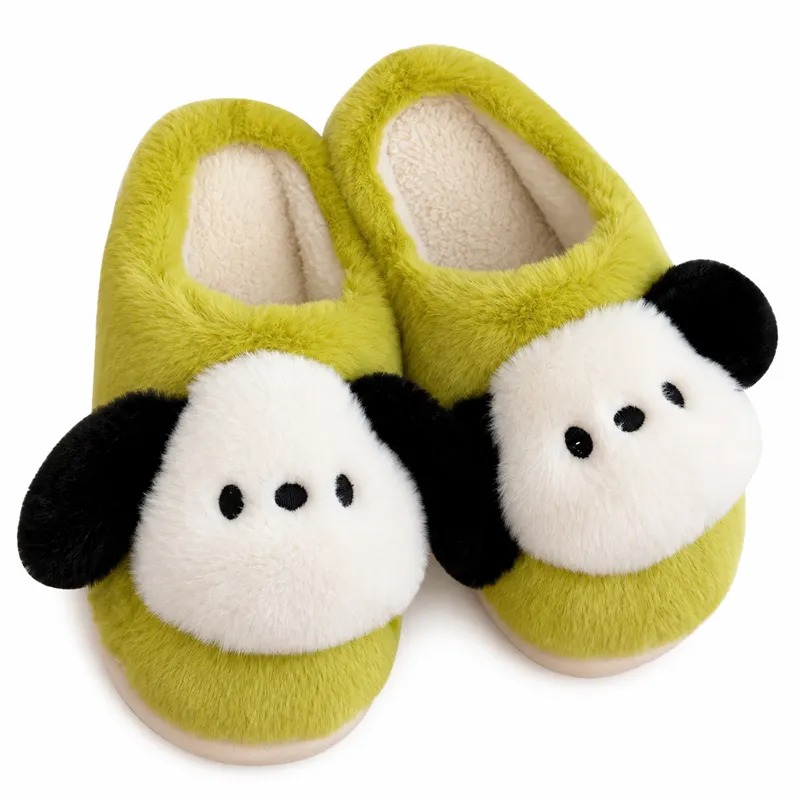
Dog Plush Slippers
The rounded muzzle uses fuller stuffing, while the floppy ears remain softer and more flexible.
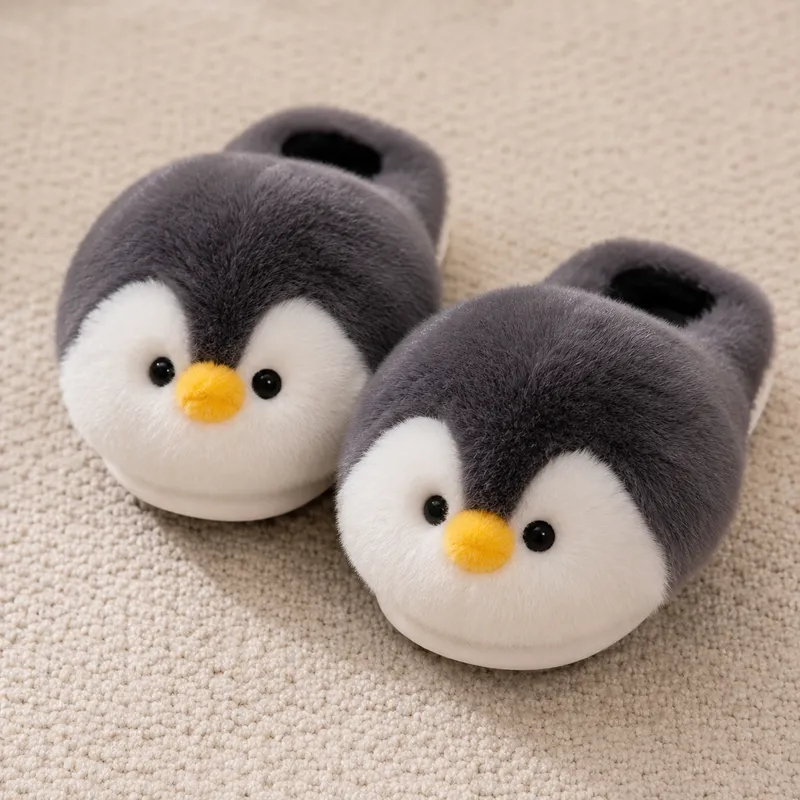
Penguin Plush Slippers
The head and beak require balanced filling to create a smooth, rounded facial contour.

Crab Plush Slippers
The claws, eyes, and body details use different stuffing densities to keep each part well shaped.
| Animal Design | Stuffing Strategy | Manufacturing Purpose |
|---|---|---|
| Dog | Fuller stuffing in the muzzle, lighter stuffing in floppy ears | Create a rounded facial profile while keeping ears soft and natural |
| Panda | Fuller stuffing around the face and cheeks | Create a rounded, friendly appearance |
| Fox | Lower density around the snout | Maintain a sharper, narrower facial profile |
| Duck / Penguin | Light stuffing in wings and balanced filling around the head | Add volume while maintaining comfort and smooth facial contours |
| Crab | Different densities for claws, eyes, and body details | Balance multiple stuffed components in one animal design |
| Unicorn / Deer | Firmer filling in horns or antlers | Support upright three-dimensional structures |
Instead of following a fixed stuffing quantity, experienced manufacturers adjust the filling density and shaping technique according to each individual animal. This approach allows every design to maintain its own personality while ensuring consistent production quality.
Which Parts Are Usually Stuffed?
Not every component of a plush slipper requires filling. Manufacturers selectively add stuffing only to the areas that need additional volume or structural support. The stuffing amount is always determined according to the approved production sample rather than a fixed standard.
Animal Ears
Light stuffing helps ears maintain their natural shape while remaining soft and flexible.
Noses & Snouts
Rounded noses and raised snouts are created by carefully controlling the stuffing density.
Animal Tails
Plush tails are usually filled with moderate-density polyester fiberfill to improve volume.
Wings
Ducks, penguins, birds, and bees often include lightly stuffed wings for balanced dimension.
Horns & Decorative Features
Unicorn horns, antlers, spikes, and similar components require firmer internal support.
Special Character Details
Stuffed cheeks, paws, claws, fins, or other details strengthen the character’s appearance.
Choosing the Right Filling Material
Selecting the appropriate filling material is just as important as determining where the stuffing should be placed. The filling should provide sufficient resilience while remaining lightweight, soft, durable, and suitable for long-term use.
For most custom animal plush slippers, manufacturers use premium polyester fiberfill, the industry-standard stuffing material for high-quality plush products. It offers excellent softness, resilience, lightweight performance, and long-term shape retention, making it ideal for creating three-dimensional animal features.
Material Note
In China, this material is commonly referred to as "PP cotton" during everyday manufacturing. However, in international trade and technical communication, polyester fiberfill is the more accurate and widely recognized industry term.
Stuffing Density Matters More Than Stuffing Quantity
Experienced manufacturers rarely ask, "How much stuffing should we use?" Instead, the more important question is, "How dense should the filling be in each part of the slipper?"
Different animal features require different stuffing densities. A rounded nose may require firmer support to maintain its shape, while ears should remain softer and more flexible. Animal tails usually receive moderate-density filling, and decorative wings require balanced support to preserve their appearance without becoming too stiff.
Before moving to the next manufacturing stage, every stuffed component is compared with the approved production sample. Workers verify the proportions, symmetry, softness, stuffing density, and overall appearance to ensure every pair meets the same production standard.
How Stuffing and Shape Forming Work
After the upper assembly has been completed, the slippers enter the stuffing and shape forming stage. During this process, flat sewn components are transformed into recognizable three-dimensional animal features through filling, manual adjustment, and continuous comparison with the approved production sample.
Step 1: Inspect Components
Workers identify every component that requires stuffing, including ears, noses, tails, wings, horns, and decorative accessories.
Step 2: Insert Polyester Fiberfill
Premium polyester fiberfill is inserted according to the approved sample and adjusted for different animal features.
Step 3: Distribute Filling Evenly
Workers distribute the filling by hand to eliminate empty spaces and prevent lumps.
Step 4: Manual Shape Forming
Every stuffed component is shaped by pressing, rotating, and gently adjusting the filling.
Step 5: Compare With Approved Sample
Workers verify facial expression, proportions, stuffing density, symmetry, and overall appearance.
Step 6: Final Visual Inspection
Each pair is checked before moving to surface finishing.
Manufacturing Controls
Stuffing and shape forming may appear simple, but maintaining the same appearance across hundreds or thousands of pairs requires strict manufacturing controls. Experienced factories establish standardized inspection points throughout production rather than relying solely on manual experience.
Stuffing Density
Different animal features require different stuffing densities to balance support and softness.
Shape Consistency
Every slipper should maintain the same three-dimensional profile as the approved sample.
Left-and-Right Symmetry
Both slippers should present matching proportions, facial expressions, and decorative details.
Hand Feel
The finished slipper should remain soft and comfortable while holding its structure.
Approved Sample Reference
The approved sample serves as the quality benchmark throughout manufacturing.
Visual Inspection
Every pair is checked for symmetry, stuffing quality, overall shape, and production standards.
Common Manufacturing Problems
Without proper stuffing and shape forming, even well-sewn slippers can develop quality issues that affect both appearance and customer satisfaction.
- Uneven stuffing between the left and right slippers.
- Collapsed ears, noses, or tails caused by insufficient filling.
- Oversized facial features resulting from excessive stuffing.
- Uneven filling distribution that creates visible lumps.
- Asymmetrical facial expressions after manual shaping.
- Decorative components losing their shape during transportation.
- Inconsistent appearance throughout bulk production.
Bring Your Animal Plush Slipper Ideas to Life
Looking for a reliable OEM or ODM manufacturer? From pattern development and material selection to stuffing, embroidery, sewing, quality control, and packaging, we help transform your ideas into premium custom animal plush slippers for wholesale and private label brands worldwide.
Start Your Custom ProjectWhat Happens After Shape Forming?
After stuffing and shape forming have been completed, every slipper undergoes a final visual inspection to verify its appearance, symmetry, softness, and structural stability.
Approved products then proceed to the Surface Finishing Process, where loose fibers are removed, the plush surface is brushed, and the finished product receives its final appearance.
After surface finishing, every pair enters the Needle Detection Process and other quality inspection procedures before packing and shipment.
Conclusion
Stuffing and shape forming are far more than simple filling operations. They are essential manufacturing processes that transform flat sewn components into recognizable three-dimensional animal characters while maintaining comfort, durability, and production consistency.
By carefully controlling stuffing density, manual shaping, symmetry, approved sample comparison, and quality inspection, manufacturers can consistently produce premium custom animal plush slippers for OEM, ODM, wholesale, and private label customers worldwide.
For manufacturers specializing in custom animal plush slippers, the ability to reproduce the same character accurately across every production batch is not only a manufacturing capability—it is also a reflection of factory experience, quality management, and long-term customer trust.